

By RISE Realty | Miami Commercial Real Estate Specialists
If you're a business looking for commercial space — office, industrial, retail, or warehouse — there's something you need to know before you start calling listing agents or searching online portals.
Every listing agent you contact represents the landlord. Not you.
That's not a criticism of those agents. They're doing their job. But their job is to get the best deal for the building owner — which is the opposite of what you need. This is where tenant representation comes in.
What Is Tenant Representation?

Tenant representation is a commercial real estate service where a licensed broker works exclusively on behalf of the tenant — the business looking for space — not the landlord. They find options, run the analysis, negotiate the lease, and advocate for your interests from start to finish.
The defining characteristic of a tenant rep is loyalty. They have one client in a transaction: you. They cannot represent the landlord at the same time. Their entire job is to secure you the best possible space on the best possible terms.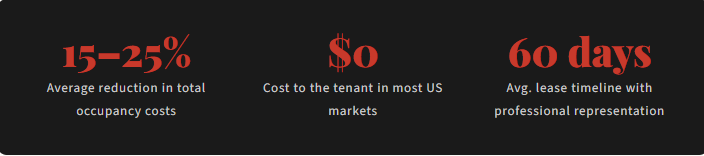
How Tenant Representation Works in Practice
The process typically unfolds in six phases.
1. Needs assessment.
Your tenant rep starts by understanding exactly what your business needs: square footage, ceiling heights (critical for industrial and cold storage), power requirements, parking, proximity to customers or suppliers, lease term flexibility, and your growth trajectory over the next 5–10 years. This step saves enormous time by filtering the market before you ever tour a building.
2. Market survey.
Your rep pulls every relevant option in the market — not just what's publicly listed, but off-market opportunities, spaces about to become available, and buildings where the landlord is motivated to fill vacancy. This is where local market knowledge creates real value.
3. Financial analysis.
Your rep builds a true apples-to-apples comparison of every option. Lease rate is only one variable. Total occupancy cost includes base rent, annual escalations, operating expenses, free rent concessions, tenant improvement allowances, parking, and the real cost of tenant buildout. Two spaces listed at the same per-square-foot rate can have dramatically different effective costs over a 5-year term.
4. Negotiation.
This is where the return on tenant representation is most visible. Your rep negotiates against landlords and listing agents who do this every day. They know what concessions are available, what comparable deals look like in the market, and which landlords have flexibility that isn't being advertised. In our experience representing South Florida tenants, professional tenant representation typically reduces total occupancy costs by 10–25% over a 5-year lease term, depending on submarket dynamics, landlord motivation, and tenant leverage.
5. Lease review.
Commercial leases are complex legal documents full of terms that significantly affect your business — assignment clauses, sublease rights, renewal options, exclusivity provisions, operating expense caps, and termination rights. Your tenant rep coordinates with legal counsel to ensure the lease you sign actually protects your interests.
6. Ongoing support.
The relationship doesn't end at lease signing. A good tenant rep continues to track your market, flag renewal timing (you typically need to start the conversation well before expiration — 18–24 months out for cold storage, 12–18 months for office, and 6–12 months for industrial), and advise on any subleasing, expansion, or renegotiation opportunities that arise during your term.
The Question Everyone Asks: What Does It Cost?
This is the part that surprises most people: in most US commercial real estate transactions, tenant representation costs the tenant nothing.
The landlord pays brokerage commissions. It's baked into how commercial leases are structured. The listing agent's commission is paid by the landlord regardless of whether the tenant shows up represented or unrepresented.
If you walk in without a tenant rep, you don't save the commission — the listing agent just keeps both sides of it. You simply lose the negotiating expertise, market knowledge, and advocacy that a tenant rep would have provided.
Said directly: in most US commercial lease transactions, hiring a tenant rep doesn't cost the tenant out of pocket — the brokerage commission structure is built into how the landlord prices the deal. There are exceptions (some off-market and direct-to-owner transactions, or where listing agreements explicitly limit cooperating broker compensation), but in the vast majority of cases, professional representation costs the tenant nothing they wouldn't pay anyway. Your tenant rep should disclose how they're compensated in your specific situation before you sign anything.
What Tenant Representation Actually Saves You
In our experience representing South Florida tenants, professional tenant representation typically reduces total occupancy costs by 10–25% over a 5-year lease term, depending on submarket dynamics, landlord motivation, and tenant leverage. On a 5-year lease for a 5,000 square foot Miami office space at $45/SF annually — a real market rate — that's a total lease value of $1,125,000. Even at the conservative end of that range, the savings through negotiation represent well over $100,000 in real value over the term.
Those savings come from multiple sources:
Free rent.
Landlords routinely offer several months of free rent to motivated tenants. Unrepresented tenants frequently leave this on the table. A tenant rep knows which markets and which landlords are offering it, and asks.
Tenant improvement allowances.
Landlords may contribute to your buildout costs — carpet, paint, partitions, HVAC modifications. The amount is negotiable and varies significantly. Most unrepresented tenants don't know the market range.
Annual escalation rates.
A lease at $45/SF with 4% annual escalations versus 3% escalations saves roughly $2.25/SF by year 5 — real money on any meaningful square footage.
Renewal options.
The right to renew at a fixed or capped rate, exercisable by the tenant, is one of the most valuable clauses in a commercial lease. Not all leases include it, and the terms vary. Your tenant rep makes sure you have it and that the terms are favorable.
Exit rights.
Termination clauses, sublease rights, and assignment provisions give you flexibility if your business circumstances change. Missing these in a lease can be enormously expensive later.
Why This Matters Especially in Miami
Miami's commercial real estate market has characteristics that make professional representation more valuable, not less.
Landlords in Brickell, Doral, Wynwood, and the Airport West corridor are sophisticated. Many are institutional — REITs, private equity-backed operators, family offices with decades of negotiating experience. They have listing agents who negotiate leases every day. Without a tenant rep on your side, you're walking into an asymmetric negotiation.
The market also has significant information asymmetry. What comparable leases actually traded at, which landlords are under pressure to fill vacancy, and what concessions are currently available in specific submarkets — this information isn't in any public listing. It lives in the relationships and transaction history of active market participants.
That's what RISE Realty brings to the table. We operate in this market daily. We know what deals look like in Brickell office, Doral industrial, Wynwood retail, and the cold storage corridor in the Airport West area. When we sit down at the negotiating table for a tenant client, we know exactly what the market supports — and we use that knowledge to get results that unrepresented tenants consistently leave on the table.
Who Needs Tenant Representation?
The short answer: any business looking for commercial space. But the value is especially clear in a few specific situations:
First-time commercial tenants. If you've never negotiated a commercial lease before, you don't know what you don't know. Tenant representation protects you from the most common and expensive mistakes.
Businesses relocating or expanding. The combination of time pressure and unfamiliarity with a new submarket creates exactly the conditions where tenants make poor decisions. A tenant rep manages the process and removes the time pressure from negotiations.
Lease renewals. Most tenants assume renewing is simpler than finding new space. In many cases, it's actually the highest-leverage negotiating moment in your entire occupancy — you have credible alternatives, the landlord has a real cost to replace you, and the market data may support significant improvement to your current terms. A tenant rep identifies and captures that leverage.
Industrial and cold storage tenants. Specialized space has specialized requirements — power, ceiling heights, dock doors, refrigeration systems, floor load capacity — that generic brokers don't always evaluate correctly. Getting these specifications wrong in a lease can create operational problems that cost far more than a broker's commission.
The Bottom Line
Commercial real estate is one of the largest line items in any business's operating budget. The lease you sign will bind your business for years. The terms negotiated in a single week of conversations can affect your profitability for the entire duration of that lease.
Tenant representation is the professional service designed specifically to protect you in that process — and in most cases, it doesn't cost you a dollar out of pocket.
At RISE Realty, tenant representation is one of our core services. We represent businesses across Miami-Dade — in office, retail, industrial, and cold storage — with the market knowledge and negotiating experience to deliver real results.
If you have a lease coming up, a space search in progress, or even just questions about whether your current terms are competitive, that's exactly the conversation we're here to have.
Free Download: RISE Realty Tenant Lease Audit Checklist
Not sure if your current lease is costing you money? Run it against our free 20-point checklist — evaluate your commercial lease against current Miami market standards in 15 minutes.
📋 Download the Free Checklist →
About RISE Realty: RISE Realty is a Miami-based commercial real estate firm specializing in tenant representation, investor advisory, industrial and cold storage real estate, and buyer and seller services across South Florida. Our team is led by Keith Alan Darby, CCIM — Principal & Broker. The CCIM designation is held by fewer than 6% of commercial real estate professionals nationwide and represents the industry's highest standard of education and transactional expertise.
Keith Alan Darby, CCIM
Principal & Broker · RISE Realty · South Florida Tenant Representation
Direct: 305-720-7925 Office: 305-859-1606
Email: [email protected] Web: riserealty.com
Specializing in tenant representation for office, industrial, cold storage, and retail across Miami-Dade, Broward, and Palm Beach.
Check out this article next