

Boutique by Design. Execution by Discipline.
By Keith Alan Darby, CCIM
You see it on almost every commercial listing in Miami: NNN. Triple net. It's one of the most common lease structures in the market and one of the most misunderstood by the tenants signing them.
The confusion isn't about the term, most tenants have heard of it. It's about what "net" actually means when the invoices start arriving.
What NNN means
In a gross lease, you pay rent and the landlord covers most operating costs. In a triple net lease, you pay rent plus your share of three additional cost categories: property taxes, building insurance, and common area maintenance (CAM). The landlord passes these expenses directly to tenants, usually pro-rated by the square footage you occupy.
The base rent number on the listing is not what you'll pay. The NNN charges on top of it are.
The number that surprises tenants
How much those charges add depends heavily on property type. In Miami-Dade, retail and older office space typically carries NNN charges of $8 to $18 per square foot per year. Industrial runs well below that, often in the $3 to $6 range, though Florida's climbing insurance costs are pushing the insurance component higher.
On a 10,000 SF warehouse, even $5/SF in NNN charges is $50,000 a year in operating expenses, on top of base rent.
Take a Doral or Airport West warehouse quoted at $16/SF NNN. That isn't $16. Add roughly $5/SF in taxes, insurance, and CAM, and your effective rent is closer to $21/SF. That's the number your budget needs to be built around.
Most tenants don't find this out until the first CAM reconciliation, when the landlord sends a year-end true-up bill for the difference between estimated charges and actual costs. That surprise invoice has blindsided more than a few Miami businesses in their first full year of occupancy.

A close-up of a commercial lease showing NNN operating expense line items, the charges most Miami tenants don't see until after they've signed
What's buried in CAM
Common area maintenance is where the real complexity lives. In theory, it covers the costs of maintaining shared spaces, parking lots, lobbies, landscaping, exterior lighting. In practice, CAM clauses vary enormously from lease to lease, and landlords have significant latitude in what they include.
Watch for:
- Management fees: some landlords charge an administrative fee of 10 to 15% of CAM costs as a separate line item. That's overhead being passed to you.
- Capital expenditure inclusions: roof replacement, HVAC upgrades, and parking lot resurfacing should be landlord costs, but poorly negotiated leases push them into CAM.
- Gross-up provisions: in multi-tenant buildings, landlords sometimes "gross up" operating costs to 100% occupancy even when the building isn't full. If not handled carefully, you can pay more than your actual share.
- Exclusions you didn't negotiate: every cost you fail to exclude in the LOI is a cost that can show up in the CAM reconciliation.
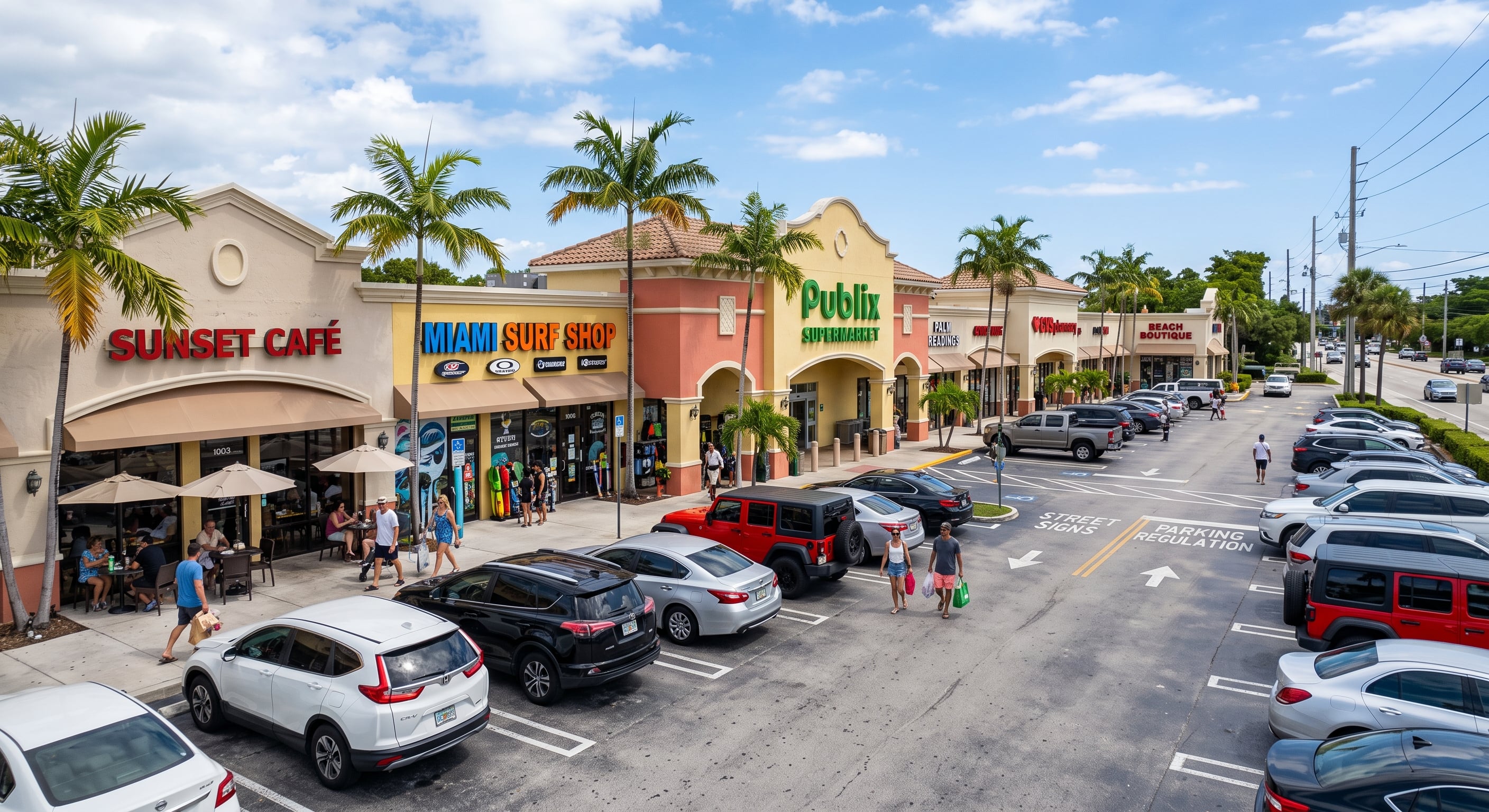
The shared parking lot and exterior of a Miami retail center, common area costs like this are what CAM charges are built around and passed through to tenants
What a well-negotiated NNN lease looks like
The goal isn't to avoid NNN, it's the dominant structure in Miami commercial leasing and in many cases works fine for tenants. The goal is to negotiate the terms before you sign so there are no surprises.
A properly negotiated NNN lease includes:
- A CAM cap: limits year-over-year increases in controllable operating expenses, typically 3 to 5% annually.
- An audit right: your right to review the landlord's expense calculations and dispute discrepancies.
- Defined exclusions: capital expenditures, management fee caps, and specific costs that cannot be passed through to tenants.
- Estimated NNN disclosures: a landlord-provided estimate of current NNN charges so your budget is accurate from day one.
Every one of these protections is easier to secure at the LOI stage than after the lease is drafted.

A tenant representative reviewing NNN lease terms with a Miami business owner before signing. The point where CAM caps and audit rights are negotiated
The right question to ask before you tour
Before you fall in love with a space, ask the listing agent for the current NNN amount per square foot and the last three years of CAM reconciliation history. That history tells you whether the landlord's estimates are accurate or habitually understated, and whether tenants have been hit with large year-end true-ups.
If the listing agent can't or won't provide that, that's information too.
👉 Talk to us before you sign: Tenant Representation →
👉 Download the Tenant Lease Audit Checklist →
Related reading:
Doral Industrial Real Estate in 2026: What Smart Tenants Already Know →
Disclaimer: This article is for informational purposes only and does not constitute legal, financial, or real estate transactional advice. NNN lease structures, CAM provisions, and operating expense pass-throughs vary by property, landlord, and lease document. Consult qualified professionals before making lease decisions.
About RISE Realty: RISE Realty is a Miami-based commercial real estate firm specializing in tenant and buyer representation, with a focus on industrial and cold storage real estate, across South Florida. RISE represents tenants and buyers exclusively, which means undivided loyalty on every deal. Our team is led by
Keith Alan Darby, CCIM, President and Designated Broker of RISE Realty. The CCIM designation is held by a small fraction of commercial real estate professionals nationwide and represents the industry's highest standard of education and transactional expertise.
Keith Alan Darby, CCIM
President and Designated Broker | RISE Realty · South Florida Tenant Representation
Direct: 305-720-7925 · Office: 305-859-1606
Email: [email protected] Web: riserealty.com
Specializing in tenant representation for office, industrial, cold storage, and retail across Miami-Dade, Broward, and Palm Beach.

Check out this article next