
Boutique by Design. Execution by Discipline.
By Keith Alan Darby, CCIM
A tenant improvement allowance, TI allowance, or TIA, sounds like a straightforward deal: the landlord gives you money to build out your space, you move in and pay rent. Simple enough.
It's not. How a TI allowance is structured, negotiated, and spent can be the difference between a space that works for your business and a lease that quietly costs you far more than you realize.
What a TI allowance actually is
A tenant improvement allowance is a landlord contribution toward the cost of building out a commercial space to your specifications. It's expressed as a dollar amount per square foot, and the range depends heavily on property type. In Miami, office TI allowances typically run $30 to $80/SF and retail roughly $20 to $50/SF. Bulk warehouse and industrial space is a different story: TI there is often just a few dollars per square foot, because a shell is a shell and there's far less to build out. Within each type, the number moves with the submarket, building class, and how badly the landlord wants the deal.
The allowance is not free money. It's factored into the economics of the deal. A landlord offering a generous TI on a 5-year lease is recovering that investment through your rent. Understanding this relationship, and negotiating accordingly, is how tenants get real value from it.
The mistakes that cost tenants
Mistake 1: Treating the allowance as the budget. The TI allowance is a contribution, not a ceiling. If your buildout costs $120/SF and the landlord is offering $50/SF, you're responsible for the remaining $70. Tenants who don't model the full buildout cost before signing end up either compromising on their space or writing checks they didn't plan for.
Mistake 2: Not defining what it covers. TI allowances can be written broadly or narrowly. Some cover only hard construction costs: walls, flooring, ceilings, electrical. Others can include furniture, fixtures, equipment, and even moving costs if you negotiate it. Whatever is not explicitly covered in the lease is your cost. Get the scope defined in the LOI.
Mistake 3: Missing the deadline. TI allowances almost always come with a use-it-or-lose-it deadline, typically 12 to 18 months from lease commencement. If your buildout is delayed and you miss the draw deadline, the unused portion reverts to the landlord. Construction timelines in Miami are unpredictable, and Miami-Dade permitting alone can add months before a single wall goes up. Negotiate a longer draw window than you think you need, and start the permit process the day you sign.
Mistake 4: Underestimating the recapture risk. If you terminate the lease early, voluntarily or otherwise, many TI provisions require you to repay a pro-rated portion of the allowance. On a 5-year lease with a $200,000 TI, leaving at year two can mean repaying $120,000 on top of any termination penalties. Read the clawback language carefully before you sign.
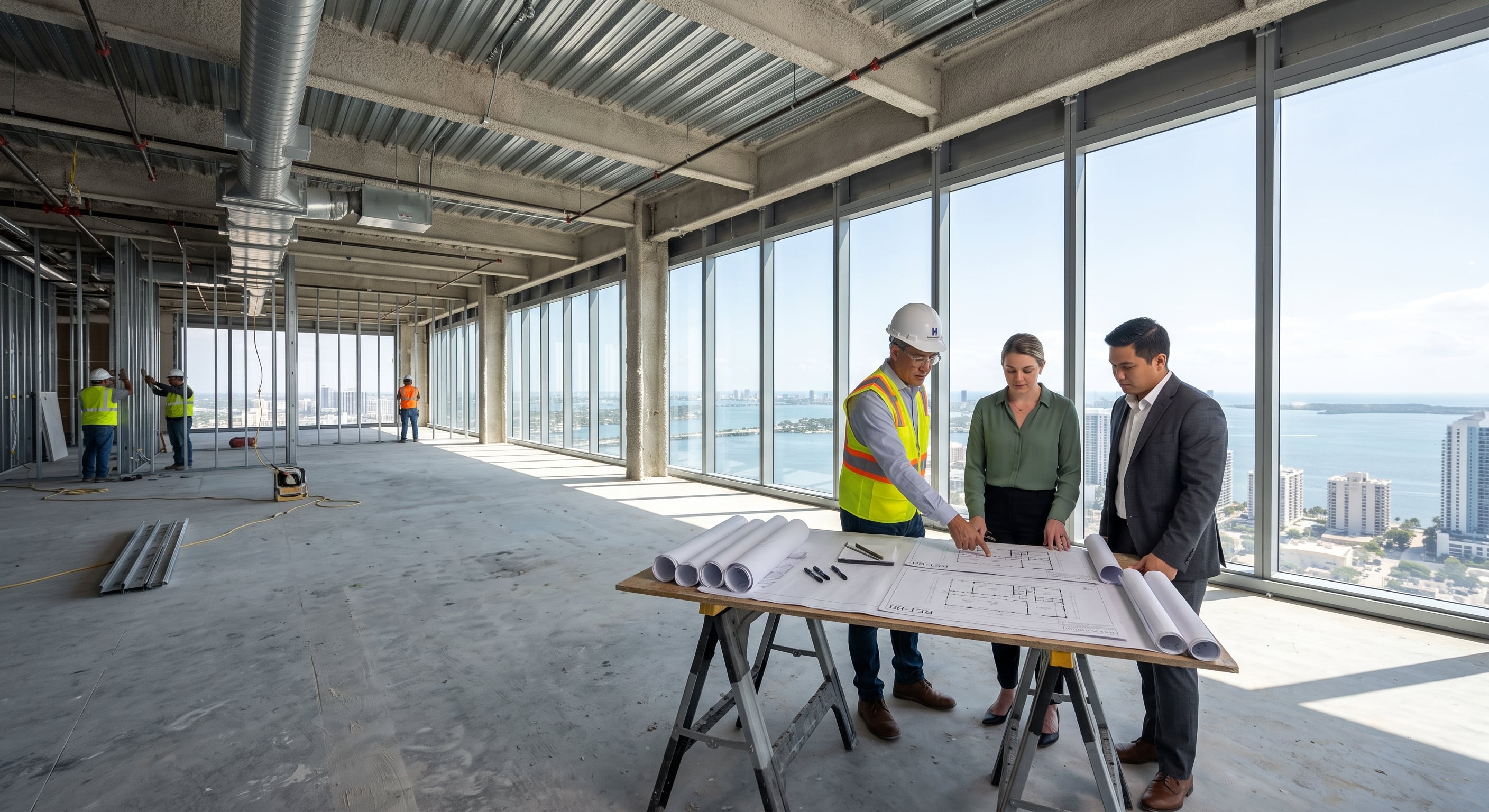
 A Miami business owner reviewing a buildout cost estimate that exceeds the landlord's TI allowance, a common outcome when scope and budget aren't defined before signing.
The allowance that's actually a loan
Not all TI is a concession. When a landlord offers more than the base allowance, that extra money is usually amortized back into your rent, typically at 8 to 10 percent interest over the lease term. In plain terms, it's a loan, and you repay it with interest through a higher rent number. Most tenants never recognize it as debt because it's folded into the rent.
Before you accept "additional" allowance, ask which portion is base (a true concession) and which portion is amortized (financed), and at what rate. Amortized TI can still be the right move when it funds improvements you genuinely need, but you should price it as the financing it is, not treat it as free money.
What strong TI negotiation looks like
The best outcomes come from treating the TI allowance as one variable in the full deal economics, not as a standalone concession.
- Push for a higher allowance in exchange for a longer term. Landlords are more willing to invest in a buildout when they have a longer recovery period. A 7-year lease often unlocks significantly more TI than a 5-year.
- Negotiate the scope broadly. Get "soft costs" included, permits, architect fees, project management, not just hard construction.
- Ask for the allowance to be paid directly to your contractor. Some landlords pay tenants who then pay contractors. Direct payment protects you from cash flow timing risk.
- Request the right to use unused allowance as rent credit. If your buildout comes in under budget, an unused TI balance applied to future rent is real money recovered.
- Confirm there's no landlord approval bottleneck. Some leases require landlord sign-off on every contractor, change order, and material selection. That approval process can delay your buildout and push you toward the draw deadline.
 A newly completed commercial office buildout in Miami, the result of a well-negotiated TI allowance with clearly defined scope, draw timeline, and cost exclusions.
 What happens to your buildout at the end
The improvements you pay to build usually become the landlord's property the moment they're installed. That part is standard. The trap is the restoration clause: many leases require you to remove specialized work and return the space to its original condition, at your own cost, when the lease ends.
For a straightforward office, that's minor. For a cold storage tenant pulling out refrigeration and insulated panels, or a lab tenant removing specialized systems, restoration can be a six-figure exit cost you never budgeted for. Negotiate this at the LOI, not at move-out. Push to have your improvements deemed the landlord's property with no removal obligation, or at minimum, get a clear, capped list of exactly what you must remove so the exit cost is known before you sign.
The number that changes everything
On a 5,000 SF office in Brickell at $55/SF in TI, the allowance is $275,000. The difference between a well-negotiated TI clause and a poorly negotiated one (scope, draw window, clawback terms) can easily swing that number by $50,000 to $100,000 in real economic impact over the lease term. That's the number most tenants leave on the table by treating the TI as an afterthought.
 A tenant and landlord finalizing a lease agreement in Miami. The outcome of TI allowance terms negotiated at the LOI stage, not after the lease was drafted.
👉 Talk to us before you sign: Tenant Representation →
👉 Download the Tenant Lease Audit Checklist →
Related reading:
What NNN Actually Means and What Miami Tenants Get Wrong About It →
Disclaimer: This article is for informational purposes only and does not constitute legal, financial, or real estate transactional advice. TI allowance structures, clawback provisions, and buildout requirements vary by property, landlord, and lease document. Always consult qualified professionals before making lease decisions.
About RISE Realty: RISE Realty is a Miami-based commercial real estate firm specializing in tenant and buyer representation, with a focus on industrial and cold storage real estate, across South Florida. RISE represents tenants and buyers exclusively, which means undivided loyalty on every deal. Our team is led by Keith Alan Darby, CCIM, President and Designated Broker of RISE Realty. The CCIM designation is held by a small fraction of commercial real estate professionals nationwide and represents the industry's highest standard of education and transactional expertise.
Keith Alan Darby, CCIM
President and Designated Broker | RISE Realty · South Florida Tenant Representation
Direct: 305-720-7925 · Office: 305-859-1606
Email: [email protected] Web: riserealty.com
Specializing in tenant representation for office, industrial, cold storage, and retail across Miami-Dade, Broward, and Palm Beach.
Check out this article next